Tournament Draw Generator
100% Free • No Sign-up Required

Free Tournament Bracket Maker & Generator

Make a single elimination, double elimination, round robin, Swiss, or 3-game guarantee bracket in seconds. Share live scores with players and fans, then print it or export to PDF and Excel.

256
Teams or Players
< 1s
To Build a Bracket
Free
No Hidden Fees

Choose Your Format

Select from our fully-supported tournament formats to generate a bracket.

Learn more about tournament formats ↓

Understanding Tournament Formats

Single Elimination

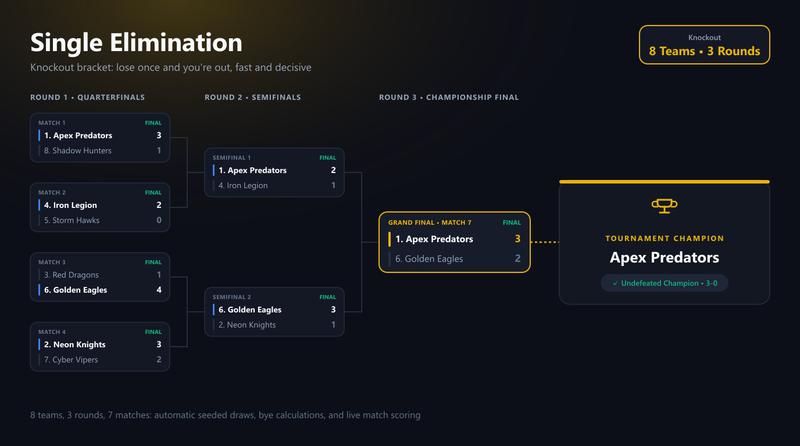
A single-elimination tournament—also called a knockout or sudden death tournament—is a type of elimination tournament where the loser of each bracket is immediately eliminated from winning the championship or first prize in the event. This format is the fastest way to determine a winner, making it ideal for events with limited time or large fields of up to 256 players or teams. The stakes are always high, as every match could be a player's last.

Single Elimination tournament bracket diagram showing knockout rounds leading to finals

Double Elimination

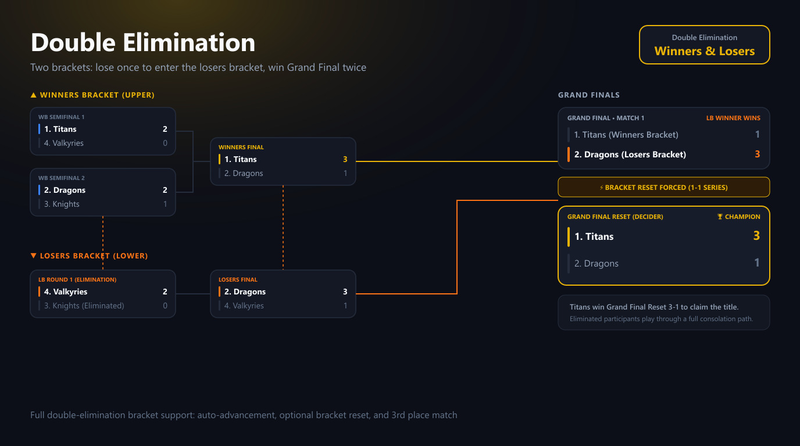
A double-elimination tournament is broken into two sets of brackets, the Winners Bracket and Losers Bracket. After the first round, the winners proceed into the Winners Bracket and the losers proceed into the Losers Bracket. This format ensures that every participant is guaranteed to play at least two matches, offering a chance for a comeback even if a team has an off-game in their first round. It is widely used in competitive gaming, wrestling, and baseball.

Double Elimination tournament bracket diagram showing winners and losers brackets converging

Round Robin

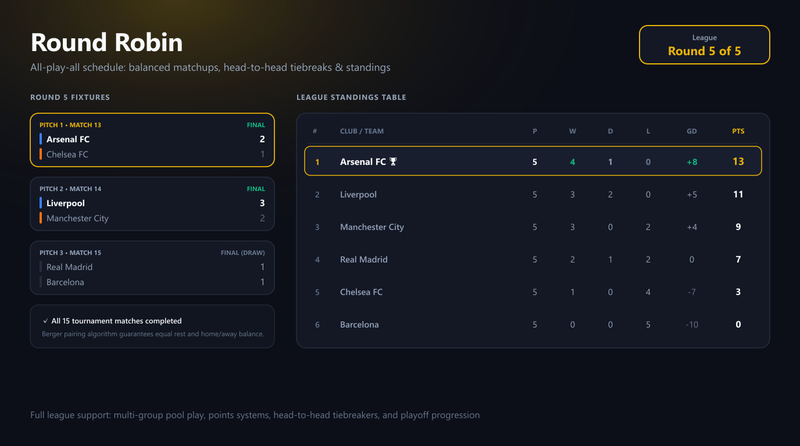
In a round-robin tournament, each contestant meets all other contestants in turn. It provides the fairest way of determining a champion, as it measures the competitors against all other players rather than relying on the luck of the draw. This format is universally used in league sports, group stages of the World Cup, and chess tournaments. It's best used when you want a highly accurate ranking of all teams, and you have plenty of time for many matches.

Round Robin all-play-all tournament schedule matrix and standings table diagram

Swiss System

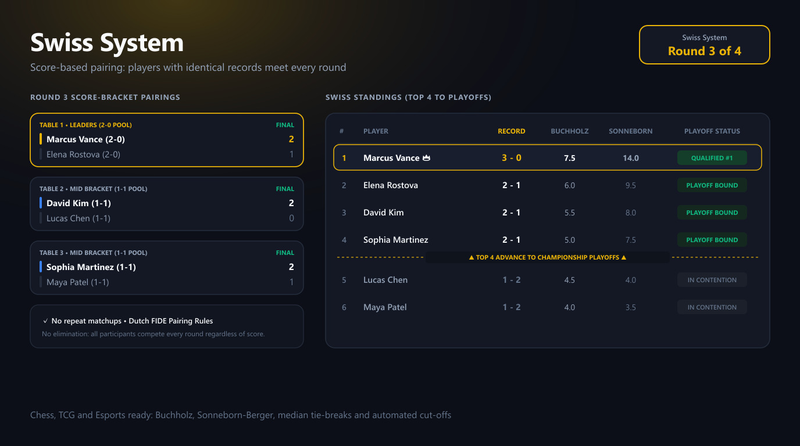
The Swiss-system tournament is a non-eliminating tournament format which features a predetermined number of rounds of competition. Competitors meet one-to-one in each round and are paired using a predetermined set of rules designed to ensure that each competitor plays opponents with a similar running score, but not the same opponent more than once. It's highly popular in chess, card games like Magic: The Gathering, and eSports qualifiers.

Swiss System tournament pairing diagram showing progressive score-based rounds

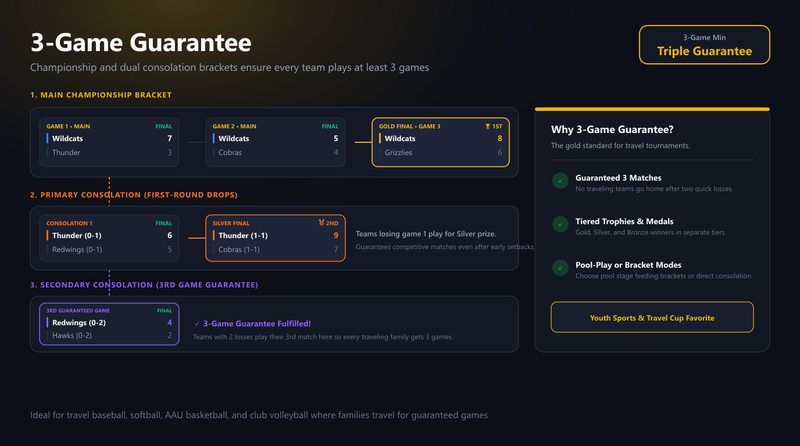
3-Game Guarantee

The 3-game guarantee format is incredibly popular in youth sports and travel tournaments. Similar to a double elimination bracket, but with an extra safety net, it guarantees that families traveling long distances will see their teams play at least three times. Teams that lose their first two games are placed into a consolation bracket to play out their guaranteed games, ensuring maximum participation value for everyone involved.

3-Game Guarantee tournament bracket diagram showing main and dual consolation brackets

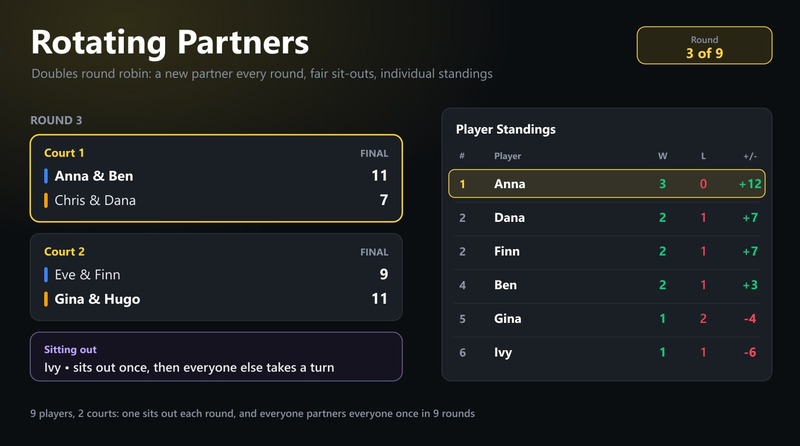
Rotating Partners

In a rotating partners round robin, also called a mixer or social round robin, players sign up on their own instead of as fixed teams. Every round, each player gets a new partner and new opponents, and when the players don't fill every court, sit-outs are shared out fairly. Results count for each player, so the standings show who played best across all their partners. It is the go-to format for pickleball socials, padel Americanos, and tennis and badminton club nights, with a mixed doubles option that pairs one player from each of two lists.

Rotating partners doubles round robin: courts for round 3, the player sitting out, and individual standings

Everything You Need to Run Your Tournament

A frictionless platform built for organizers and players alike.

No Signup Needed

Completely free and instant access. Start generating brackets without jumping through hoops or giving up your email address.

Print, PDF, & CSV Export

Download professional PDF brackets, print them instantly, or export your participant lists to CSV format for easy management.

Broadcast Your Tournament

Share a real-time spectator view link. Let players and fans follow the action live on any screen or device.

Unlimited Tournaments

Run as many events as you need. We don't cap your creativity or charge you for generating multiple brackets.

6 Tournament Formats

Single elimination, double elimination with a losers bracket, round robin with group stages, Swiss system, 3-game guarantee, and rotating partners doubles. Up to 256 teams or players, with byes added automatically.

Ready to Start?

Your bracket is just a click away.

Create Bracket

How it works

Free bracket maker and tournament generator for any sport

Tournament Draw Generator is a free online bracket maker for anyone who runs a competition, from a six-team pickleball social to a 256-player esports open. Pick a format, paste in your teams or players, and the tournament generator builds every round, matchup, and bye in about a second. There is no account to create, no limit on how many tournaments you make, and nothing to download. The same link works on a phone at the court, a laptop at the scorer's table, and a TV in the clubhouse.

Most free tools stop at drawing an empty bracket. This one runs the whole event: you enter scores as games finish, winners move forward on their own, standings update themselves, and everyone following the link sees each result within seconds.

How to make a tournament bracket in four steps

  1. 1

    Choose a format

    Single elimination, double elimination, round robin, Swiss system, 3-game guarantee, or a doubles round robin with rotating partners. Not sure which fits? The format guide above compares them, and the FAQ below covers the usual cases.

  2. 2

    Add your teams or players

    Type or paste up to 256 names, one per line. Pick the sport and name the tournament, or let the generator suggest a name for you.

  3. 3

    Choose the seeding

    Seed by ranking so the strongest teams meet as late as possible, use a random draw, set the matchups by hand, or (in single elimination) let players join the draw through a link.

  4. 4

    Create, share, and score

    Your bracket opens instantly. Share the spectator link or its QR code, enter results as games end, and print or export a copy whenever you need one.

Six tournament formats in one bracket generator

Every format follows the rules organizers already use, so the bracket you get matches what your players expect.

  • Single elimination. The classic knockout bracket: lose once and you are out. The single elimination bracket generator handles seeding, byes, and an optional third-place game.

  • Double elimination. A first loss drops a team into the losers bracket instead of ending its day. The double elimination bracket maker builds both brackets, the grand final, and an optional bracket reset.

  • Round robin. Everyone plays everyone. The round robin generator creates single, double, or triple round robin schedules, league tables, and group stages that feed a knockout final.

  • Swiss system. Nobody is knocked out, and each round pairs players on the same score. The Swiss tournament generator tracks Buchholz and other tie-breaks and can finish with a top-cut playoff.

  • 3-game guarantee. A favorite for youth baseball, softball, basketball, and volleyball weekends. The 3-game guarantee bracket makes sure every team plays at least three games, through pool play or consolation games.

  • Rotating partners. For socials where players come on their own. The doubles round robin generator gives everyone a new partner and new opponents every round, shares out sit-outs fairly, and ranks each player by wins or by points, Americano style.

Byes, seeding, and random draws worked out for you

A bracket needs 2, 4, 8, 16, 32, 64, 128, or 256 slots, so the hard part of making one by hand is working out the byes. Enter 6, 12, or 100 teams and the generator picks the bracket size, gives the byes to the top seeds, and places everyone so the bracket stays balanced. Seeded brackets follow the standard order (1 vs 8, 4 vs 5, 2 vs 7, and 3 vs 6 in an eight-team draw), so the top two seeds can only meet in the final. To see exactly how it works for your field, open thebracket for your number of teams, from a 6 team bracketto a 32 team one.

Rather leave it to luck? Switch to a random draw and the names are shuffled into the bracket, which makes it a quick random bracket generator for game nights, office competitions, and open cups. In round robin and Swiss events with an odd number of players, one player sits out each round, and you decide how many points that bye is worth.

Live brackets you can share, print, and export

Every tournament comes with two links: an admin link for entering scores and editing the event, and a read-only spectator link. Players, parents, and fans open the spectator link, or scan its QR code, to follow live scores, standings, and upcoming matches on any device, with no app and no login.

When you need paper, the print studio lays out a printable bracket or fixture sheet on A4 or US Letter, ready to pin on the wall or save as a PDF. The CSV export opens in Excel, Google Sheets, and Apple Numbers with every round, matchup, seed, score, and winner in its own column, so you never have to build a tournament bracket in a spreadsheet again.

Bracket, draw, or fixtures: one tool, whatever you call it

Organizers call the same thing by different names depending on where they play. In the United States and Canada it is a tournament bracket. In the UK, Ireland, Australia, New Zealand, India, and South Africa a knockout bracket is usually called a tournament draw or knockout draw, and a league schedule is a fixture list. It is the same generator either way: usesingle elimination for a knockout draw,round robin for league fixtures and group stages, and double elimination or a 3-game guarantee when every team should get more than one game.

Built for organizers in every sport and game

Clubs use the bracket maker forpickleball round robins,padel Americanos, tennis ladders, soccer and football cups, basketball and volleyball tournaments, and travel baseball and softball weekends. Chess clubs and card game stores run Swiss events, esports communities run gaming brackets and LAN tournaments, and schools, churches, and workplaces use it for sports days, cornhole, darts, table tennis, and trivia nights. Each format page has guides for popular sports, with match counts and the tie-break rules they use.

Free, private, and no sign-up

Every feature is free: all six formats, up to 256 participants, live updates, printing, and exports. You don't need an account or an email address. The tournaments you create are saved to My Tournaments in your browser so you can come back to them, and we show no ads and use no analytics trackers. Make your bracket now and have the whole tournament ready before the first game starts.

Make a bracket

Tournament Bracket FAQ

Quick answers on byes, seeding, tournament formats, and how many games to plan for.

How do you make a tournament bracket?

Pick a format, list your teams or players, decide how to seed them, and pair them round by round. If the number of teams is not a power of two (4, 8, 16, 32, and so on), give byes to the top seeds so the bracket comes out even.

With this generator it takes under a minute:

  • Choose a format: single elimination, double elimination, round robin, Swiss system, or 3-game guarantee.
  • Enter up to 256 teams or players, one per line.
  • Choose how to seed them: by ranking, at random, or by hand.
  • Click Create Tournament. Byes, rounds, and matchups are worked out for you.
  • Share the live link, enter scores as games finish, and print or export the bracket.
Choose a format and make your bracket

How does a tournament bracket work?

A tournament bracket is a tree diagram of every match. Teams are paired in the first round, each winner moves on to the next round, and the field is cut in half every round until two teams meet in the final.

The number of rounds depends on the bracket size: 8 teams play 3 rounds (quarterfinals, semifinals, and final), 16 teams play 4, 64 teams play 6, and 256 teams play 8. Seeding decides who meets whom in the first round, and byes fill the empty spots when the number of teams is not a power of two.

Make a single elimination bracket

What are the types of tournament formats?

The main types of tournament formats are single elimination (knockout), double elimination, round robin (league), Swiss system, and combination formats that run pool play or a group stage before a knockout bracket.

  • Single elimination: lose once and you are out. The fastest way to find a winner.
  • Double elimination: your first loss drops you to the losers bracket, and a second loss knocks you out.
  • Round robin: everyone plays everyone, and the best record wins. The fairest format.
  • Swiss system: nobody is knocked out, and each round pairs players who have the same score.
  • Combination: pools or groups feed a knockout bracket, as in the World Cup or a 3-game guarantee tournament.
  • Rotating partners (a mixer): players enter on their own and get a new doubles partner every round, ranked individually.

Ladder and pyramid tournaments, also called challenge tournaments, are another type used for ongoing club rankings.

Compare all 5 tournament formats

What is the difference between single elimination, double elimination, and round robin?

The difference is how many losses it takes to be eliminated and how many games you need to schedule. Single elimination knocks a team out after one loss, double elimination after two, and round robin eliminates no one.

  • Single elimination: N − 1 games, so 16 teams play 15 games. The quickest format, but half the teams play only once.
  • Double elimination: 2N − 2 or 2N − 1 games, so 16 teams play 30 or 31 games. Every team plays at least twice.
  • Round robin: N × (N − 1) ÷ 2 games, so 16 teams play 120 games. Every team plays every other team.

Choose single elimination when time is short, double elimination when one bad game should not end a team's day, and round robin when you want the most accurate standings and have time for every matchup.

How does double elimination work?

Every team starts in the winners bracket. A team that loses once drops into the losers bracket and keeps playing, and a second loss eliminates it. The winners bracket champion and the losers bracket champion then meet in the grand final.

The losers bracket champion already has one loss, so it has to beat the winners bracket champion twice. If it wins the first grand final game, both teams have one loss and a deciding game is played. This is called a bracket reset, and you can turn it on or off in this generator.

Make a double elimination bracket

What is a bye in a tournament?

A bye means a team moves on to the next round without playing. A bracket needs 2, 4, 8, 16, 32, 64, 128, or 256 slots, so when the number of teams falls in between, the empty slots become byes.

Byes go to the top seeds as a reward for their ranking. In a 6-team bracket, seeds 1 and 2 get byes into the semifinals while seeds 3 to 6 play the first round. In a round robin or Swiss tournament with an odd number of players, one player sits out each round instead, and you decide how many points that bye is worth.

How do you make a bracket with an odd number of teams?

Round the number of teams up to the next power of two, and give the difference to the top seeds as byes. The formula is: byes = next power of two − number of teams. The same rule works for even numbers that are not a power of two, such as 6, 10, or 12.

  • 5 teams: 8-team bracket with 3 byes
  • 6 teams: 8-team bracket with 2 byes
  • 7 teams: 8-team bracket with 1 bye
  • 9 teams: 16-team bracket with 7 byes
  • 10 teams: 16-team bracket with 6 byes
  • 12 teams: 16-team bracket with 4 byes

The generator places the byes for you, for anywhere from 2 to 256 teams. If you would rather nobody skips a round of the event, use a round robin or Swiss tournament, where one team sits out each round instead.

How do you seed a tournament bracket?

Seeding means ranking the teams before the tournament, by record, rating, or past results, and placing them so the strongest teams meet as late as possible. Seed 1 plays the lowest seed, seed 2 plays the second-lowest, and so on.

In an 8-team bracket the first round is 1 vs 8, 4 vs 5, 2 vs 7, and 3 vs 6, so seeds 1 and 2 can only meet in the final. If you have no rankings, use a random draw instead. This generator supports seeded, random (blind draw), and manual pairings.

What is pool play in a tournament?

Pool play is the first stage of a tournament, where teams are split into small groups called pools and play a round robin inside their pool. The pool standings then seed a single or double elimination bracket for the second stage.

Pool play gives every team several games before anyone is knocked out, which is why it is standard in youth baseball, softball, volleyball, and soccer tournaments. For example, 12 teams in 3 pools of 4 each play 3 pool games before the bracket starts.

Make a pool play tournament

How do you run a round robin with rotating partners?

List the players, not teams, and decide how many courts you have. Each round, four players share a court, two against two, and everyone gets a new partner and new opponents. When the players don't fill every court, the extras sit out in turn, and each player's results go into individual standings.

8 players on 2 courts need 7 rounds for everyone to partner everyone once. Pickleball socials, padel Americanos, and tennis and badminton club nights are all run this way.

Make a doubles round robin

What is the best tournament format for 6 teams?

For 6 teams, a round robin is usually best if you have the time: every team plays 5 games, for 15 games in total. If you only have a few hours, double elimination takes 10 or 11 games and still gives every team at least 2.

  • Round robin: 15 games over 5 rounds. The fairest option, since every team plays every other team.
  • Double elimination: 10 or 11 games. Every team plays at least twice.
  • 3-game guarantee: two pools of 3 feed a bracket, so every team plays at least 3 games.
  • Single elimination: 5 games over 3 rounds. The top 2 seeds get byes, and some teams play only one game.

For 8 to 10 teams, a full round robin grows to 28 to 45 games, so most organizers switch to pools that feed a bracket, or to double elimination.

Make a round robin schedule

How do you calculate the number of games in a tournament?

It depends on the format. With N teams or players:

  • Single elimination (knockout): N − 1 games, plus 1 if you add a third-place game. 32 teams play 31 games.
  • Double elimination: 2N − 2 games, or 2N − 1 with a bracket reset. 8 teams play 14 or 15 games.
  • Round robin (league): N × (N − 1) ÷ 2 games. 6 teams play 15 games, and a double round robin doubles that.
  • Swiss system: N ÷ 2 games per round, times the number of rounds. 32 players over 5 rounds play 80 games.

Single elimination is always the shortest, and round robin grows the fastest: 20 teams in one round robin play 190 games.

How do you make a tournament bracket in Excel or Google Sheets?

You can draw a bracket in Excel or Google Sheets by listing the teams in the first column and using cell borders to connect each pair to the next round. You also have to work out the byes, seeding, and every round by hand, and redo it if a team drops out.

A faster way is to generate the bracket here and use Export to download it as a CSV file. It opens directly in Excel, Google Sheets, and Apple Numbers, with the round, both teams, their seeds, scores, and winner of every match in their own columns.

Make a bracket and export it to Excel

Is this bracket maker free, with no sign-up?

Yes. Tournament Draw Generator is 100% free, with no account, email, or credit card required. You can create as many tournaments as you like, each with up to 256 teams or players.

Every tournament comes with a live link to share with players and fans, score tracking, printable brackets you can save as PDF, and CSV export for Excel and Google Sheets. The tournaments you create are listed on the My Tournaments page in the same browser.

Open My Tournaments